Your slides may show a chart, but your voice still needs to explain why it matters. Use Cue for your speaking sequence beside the class slides: one question, a careful account of evidence, a proposal and an ending that invites discussion.
Start from the assignment and evidence
Read the marking criteria before drafting. Decide what a listener should understand by the end, and distinguish an observation from an explanation you have not tested. The sample proposes clearer water-refill signs; its classroom observation is fictional, not research to cite.
- Write the assignment's time limit, required sources and main question outside the spoken manuscript while planning.
- For your actual topic, verify each factual claim and name its source in the spoken passage when needed. Replace every fictional observation below with your own checked evidence.
- Build a four-part argument: the question, what you know, what you suggest and what would change your mind.
Separate the speaking route from the slides
Prepare the slides in your class’s usual slide tool on a computer and open Cue separately on a phone or tablet. In an empty library choose Create deck; if you already have decks, choose New deck for the manuscript; Cue does not advance the computer’s slides.
- Copy one sample passage per card and add three cards. In Card details, use matching card and slide labels: 1 Question, 2 Observation, 3 Proposal and 4 Conclusion.
- Use Card details to add the delivery reminders. If you include a chart or photo in a card, add alternative text and check that the text still fits.
- Open Present from beginning on the phone or tablet. In More, compare Fit width and Fit to view; scroll manually if needed. Rehearse changing each computer slide yourself and using Next card separately in Cue.
Practise the argument and one challenge
Aim for your assigned duration; a three-minute practice window is a useful starting point only when it matches the assignment. The sample's length is not a measured performance. Practise once with the slide changes and once with a classmate asking a question.
- The timer runs from entry even when hidden. Open Reading controls → More → Show timer. Use the timer’s Pause timer control during preparation, then write down its starting value. Start it when you begin and keep normal pauses and laughter counted; pause only for an unrelated interruption.
- After the conclusion, pause and record the ending value, then subtract the starting value. Identify the passage that took too long; choose End reading and shorten it while keeping the source and limitation.
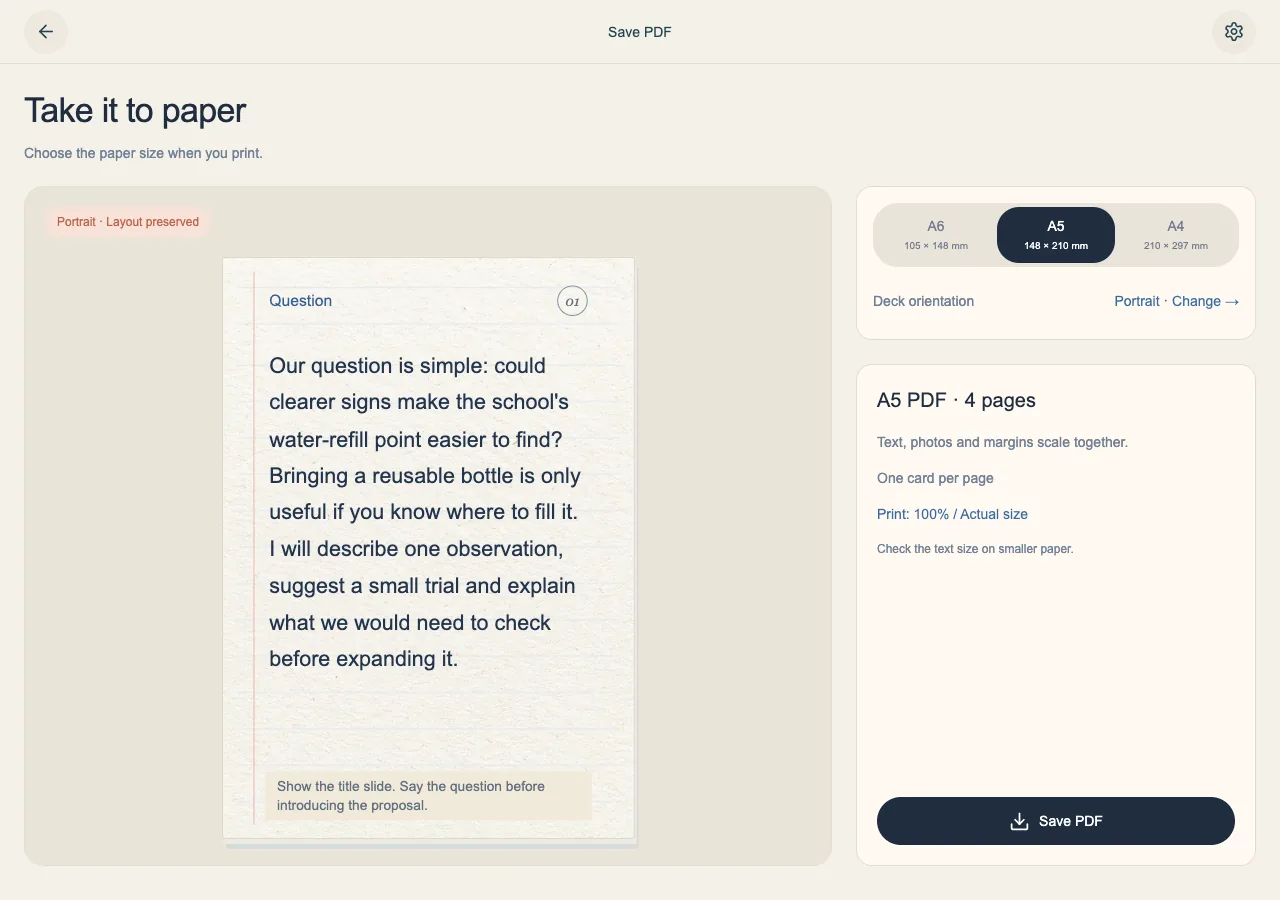
- Ask a classmate: Could signs alone solve the problem? Answer with the limits of your evidence. Export and inspect a PDF backup if needed, and rehearse the final sequence on the presentation device.
Four-card sample: finding the refill point
Original fictional classroom presentation. The lunchtime observation is an invented teaching example, with no measured counts or causal finding. Replace it with verified local evidence before presenting it as your own work; keep actual source details in the relevant passage.
Complete sample: copy one passage per card
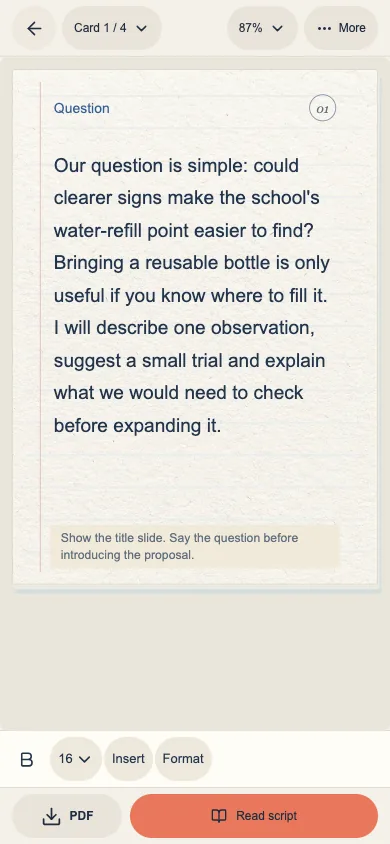
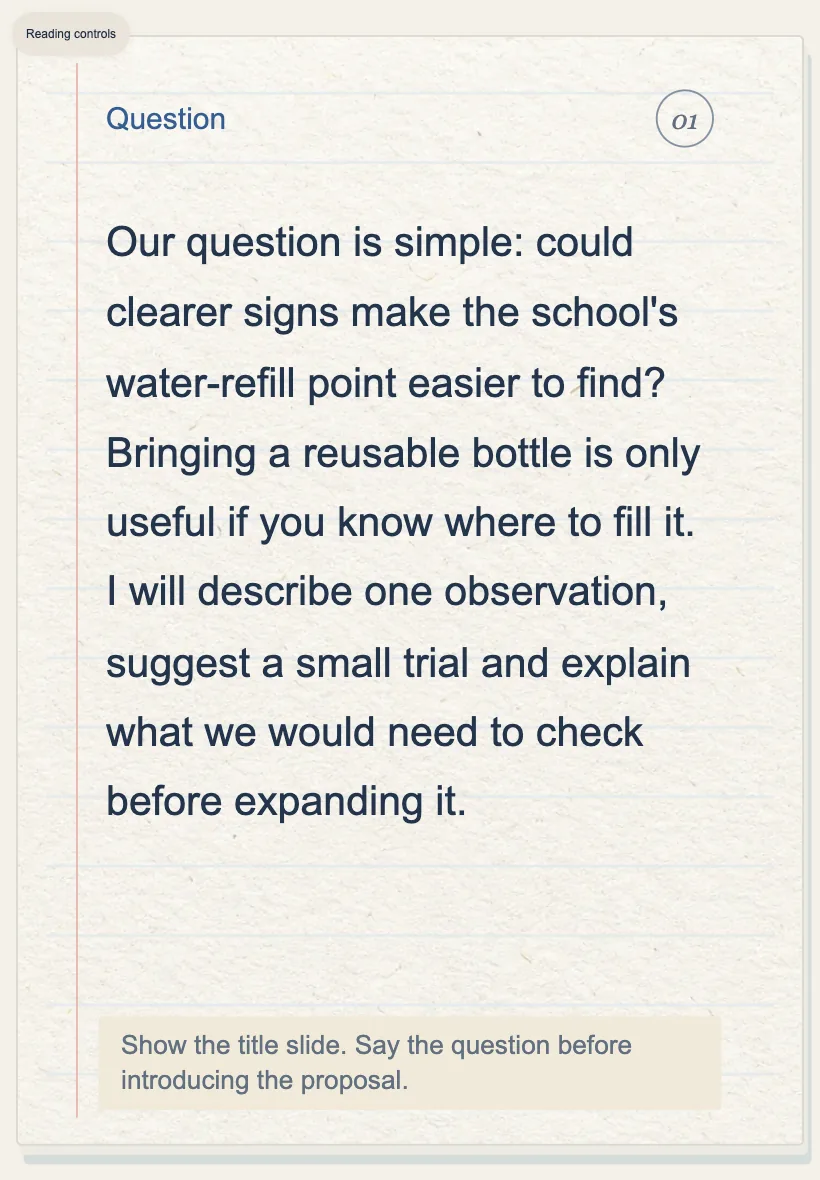
Card 1 · Question
Our question is simple: could clearer signs make the school's water-refill point easier to find? Bringing a reusable bottle is only useful if you know where to fill it. I will describe one observation, suggest a small trial and explain what we would need to check before expanding it.
Delivery reminder: Show the title slide. Say the question before introducing the proposal.
Card 2 · Observation
In our practice example, we watched the corridor during one lunch break. Some students asked where they could refill a bottle even though the refill point was nearby. That suggests a possible visibility problem. It does not tell us how many students use the point, or whether signs would change their habits.
Delivery reminder: In a real presentation, replace this observation and state the date and source. Emphasize the limitation.
Card 3 · Proposal
We propose a small trial: place a clear direction sign at the corridor entrance and a matching label by the refill point, with school permission. Compare lunch breaks of equal length at the same time on different days, first without signs and then with them. Record questions about the refill point’s location as well as use of the point, without collecting student names.
Delivery reminder: Show the proposed sign location. Distinguish the trial plan from a result.
Card 4 · Conclusion
A sign is a modest change, and it will not fix a refill point that is closed or difficult to reach. Our next step is to check access and agree on a fair trial with staff. If finding the point becomes easier, we can discuss keeping the signs. What else should we measure before deciding?
Delivery reminder: Pause before the final question. Listen to the response before returning to your evidence.
Enter each reminder in Card details → Speaker notes. Notes appear on personal cards and in PDFs. Sharing excludes them unless Include notes is selected. A reminder pasted into the card body is shared as ordinary content.